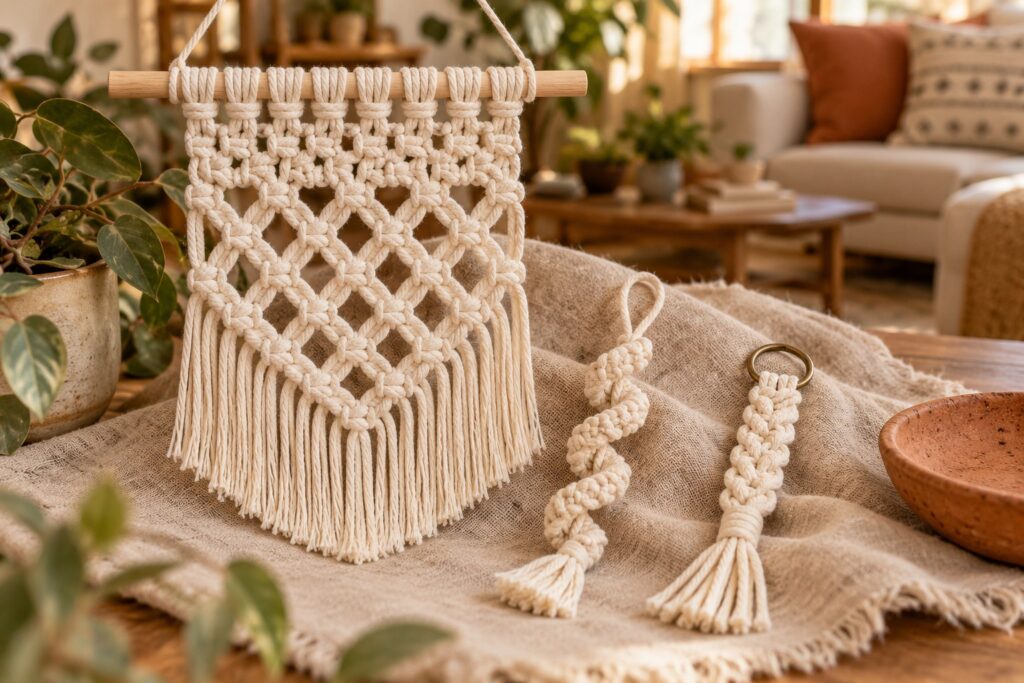
Some macrame projects begin with a simple loop and grow into something full of texture. A neat row of knots, a gently twisting cord or an airy mesh can give a handmade piece its own personality. This collection of 60 macrame knots and knot patterns offers plenty of ways to explore those details, one small sample at a time.
The collection brings together eight sections, from basic mounting and finishing knots to braids and decorative shapes. You do not need to learn all 60 before making something you love. Start with a few foundations, get comfortable handling your cord and let the more detailed patterns become ideas for your next project.
What's Inside This Macrame Collection?
1. Basic Knots: A Comfortable Place to Start
The first nine entries cover the foundations: Lark's Head Knot, Cow Hitch Knot, Square Knot, Half Hitch Knot, Double Half Hitch Knot (Clove Hitch), Vertical Double Half Hitch Knot, Vertical Lark's Head Knot, Overhand Knot and Wrapping Knot. Together, they introduce attaching cord, building a pattern and gathering loose ends.
For a first practice piece, focus on the lark's head and square knot. Notice which cords do the wrapping and which stay in the center. Those working and filler cords have different jobs, and the working cords can be used up faster. Double half hitches are a useful next step when you want rows or diagonal lines; a wrapping knot gives gathered cords a tidy finish.
2. Lark's Head Alternatives: Give Your Starting Edge More Character
Entries 10-16 explore Extended Lark's Head Knot, Double Lark's Head Knot, Crossed Lark's Head in Versions 1 and 2, Reinforced Lark's Head Knot, Cat's Paw Knot and Slingstone Hitch. These variations let the mounting edge become part of the design rather than simply a place to hang your cords.
The extended version introduces more space along a dowel, while the double version can create a hanging loop between attachment points. The crossed versions add decorative detail. Try a few side by side on a spare dowel to see which starting edge suits your wall hanging before committing to a full piece.
3. Square Knot Patterns: From Simple Columns to Soft Texture
This is the largest section, with eleven entries numbered 17-27: Square Knot Sennit, Square Knot Sennit – Multicolor, Alternating Square Knot Mesh, Half Knot Spiral, Berry Knot, Switch Knot, Square Knot Picot, Circular Fishbone Pattern, Fishbone Mesh, Wave Knot and Alternating Half Knot Pattern. A sennit is a repeated sequence of knots that forms a length of cordwork.
These patterns show how much variety can grow from familiar movements. A square knot sennit makes a compact column, alternating square knots create open mesh, and repeated half knots produce a spiral. Berry knots bring raised texture, while picots add loops. Choose a plain sennit first, then explore one change in spacing, color or texture at a time.
4. Vertical Lark's Head Patterns: Explore Loops and Open Shapes
Entries 28-33 include Alternating Vertical Lark's Head Knot (Basic), Alternating Vertical Lark's Head Knot (Variation 1), Picot Vertical Lark's Head Knot Pattern, Criss Cross Vertical Lark's Head Knot Pattern, Buttonhole Vertical Lark's Head Knot Pattern and Diamond Vertical Lark's Head Knot Pattern.
This family offers another way to create repeating lines and open spaces. The names give you a useful starting point for choosing a look: small loops, crossing lines or diamond shapes. Practice the basic vertical lark's head knot first, then keep a ruler nearby as you explore patterns where consistent spacing helps the design stay balanced.
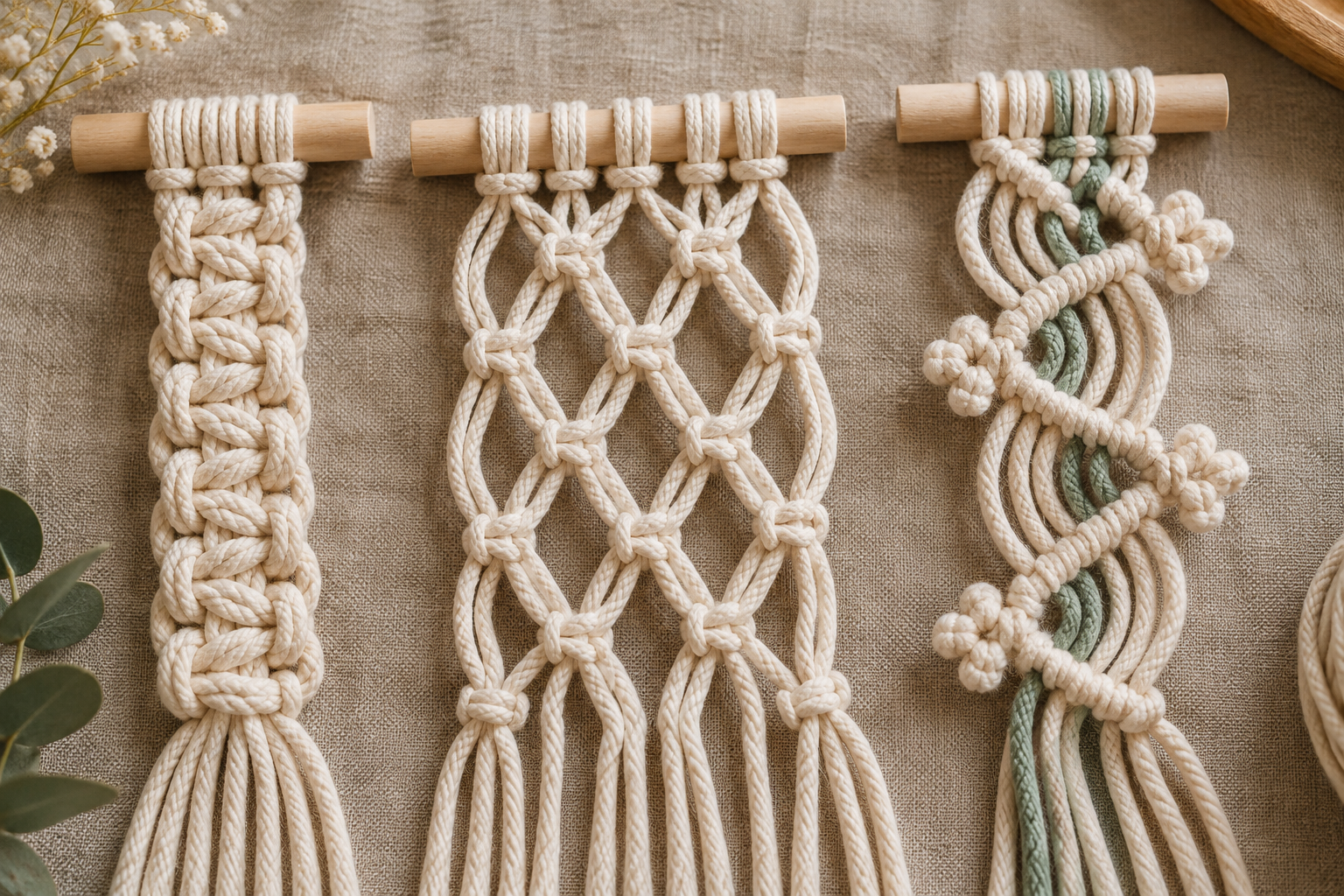
5. Half Hitch Patterns: Chains, Spirals and Relaxed Texture
The next six entries, 34-39, are Half Hitch Spiral, Alternating Half Hitch Chain, Alternating Half Hitch Mesh, Alternating Half Hitch Chain Mesh, Reverse Double Half Hitch Knot and Cobblestone Pattern (Untightened DHHK). Here, DHHK means double half hitch knot.
This section is a lovely place to explore the effect of tension. Spirals and chains give narrow cord sections character, while the cobblestone pattern uses loosened double half hitches for a more irregular texture. The alternating half hitch mesh is delicate, so plan to support it with other knot sections. A small swatch makes it easier to compare loose and snug results before choosing a larger design.
6. Endless Falls Patterns: A Different Kind of Repetition
Entries 40-45 introduce Endless Falls Knot, Mystical Chain Knot, 6 Strand Endless Falls Knot, Small Circle Sennit, Reversed Endless Falls Knot and Alternating Endless Falls Mesh. This group adds another family of repeating textures to your practice collection.
The six-strand variation has a ladder-like appearance, while the small circle sennit combines endless falls knots with double half hitches. The reversed version offers a knit-like texture. Turn your sample over as you work: the front and back can look quite different, giving you another detail to consider when planning a decorative piece.
7. Braids: Bring Familiar Weaving Into Your Macrame
The five braid entries, 46-50, are 3 Strand Braid, 4 Strand Braid, 5 Strand Braid, 6 Strand Braid and Single Cord Braid. They offer a change of rhythm from knotting and introduce different ways to build a continuous length of cordwork.
Start with the three-strand braid if you already know the movement. The wider versions offer possibilities for decorative straps or belts, while the single-cord braid is an interesting option when you want to explore what one cord can do. Keep the strands organized and compare your sample's width and feel before deciding where to use it.
8. More Macrame Knots: Decorative Details and Finishing Touches
The final ten entries, 51-60, are Crown Knot, Barrel Knot, Josephine Knot, Double Coin Knot, Figure Eight Knot, Leaf Knot, Pipa Knot, Cross Knot, Rose Knot and Constrictor Knot. This section brings together sculptural accents, interlaced shapes and practical finishing ideas.
Barrel and figure eight knots are options for cord ends when you prefer a knotted finish to brushed fringe. Leaf, pipa and rose knots add distinctive decorative shapes. The crown knot appears as a plant-hanger starting option, while the constrictor knot is shown attaching a hanging cord to a dowel. Pick one detail that catches your eye and practice it separately before adding it to your main piece.
Materials to Prepare Before You Start
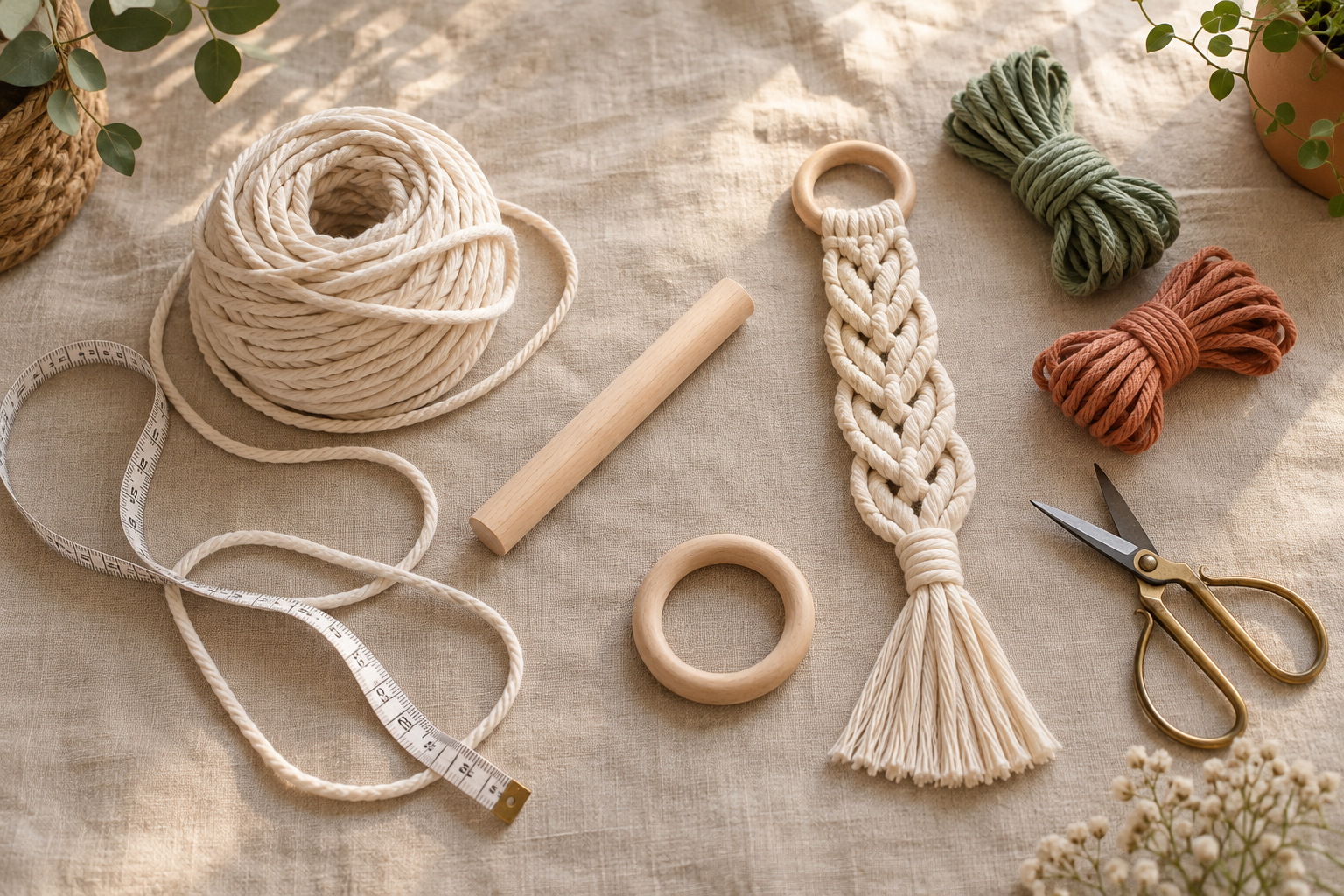
For a beginner practice setup, gather cotton macrame cord, a small dowel or ring, scissors and a ruler or measuring tape. These are suggested practice supplies rather than a universal materials list for all 60 entries. A stable place to hold the dowel will let you concentrate on the cord movements. Start with one light color so the crossings are easy to see; add contrasting cord when you are ready to explore multicolor patterns.
Cord needs vary with the knot, thickness, spacing and finished size. Make a short sample with your chosen cord before cutting supplies for a larger project, and leave room for mounting and finishing. A crochet hook can also help tuck loose ends behind completed knotwork. Keep a note of the cord you used so your favorite sample is easier to recreate.
Choosing Your First Macrame Pattern
Begin with a small sampler rather than trying to combine every technique. Mount your cords, practice a square knot column and then explore alternating square knot mesh. This gives you a manageable way to learn how a compact pattern differs from an open one. Add double half hitches when you are ready to experiment with lines, or a half knot spiral when you want a twisting detail.
Work slowly enough to notice the direction of each crossing and the spacing between repeats. If the result changes unexpectedly, compare it with your earlier knots before continuing. This collection is a guide to individual knots and patterns, so use a complete project pattern when you need finished dimensions, exact cord lengths and assembly instructions.
Find Your Favorite Macrame Texture
Whether you love simple braids, airy diamonds or small rose-shaped accents, these eight sections give you 60 ideas to explore at your own pace. A few well-practiced knots can become the starting point for a piece that feels entirely your own.
Which texture would you try first? Save your favorite idea for your next craft session, and explore more handmade inspiration at Loopmira.