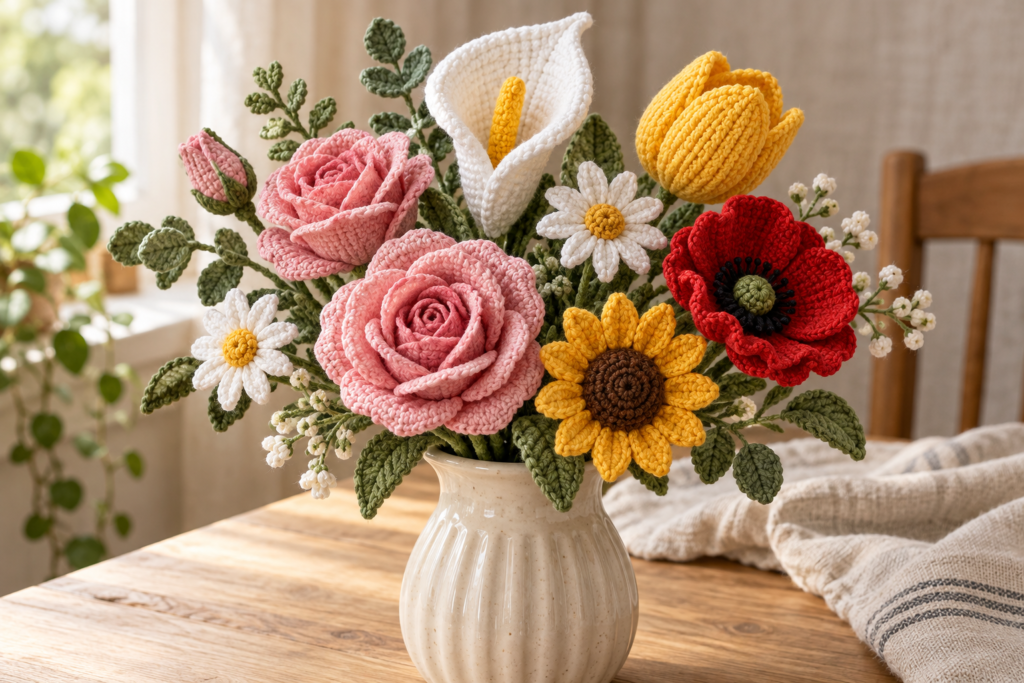
There is something lovely about a bouquet that keeps its color long after the season changes. A soft pink rose, a cheerful yellow sunflower or a tiny lilac blossom can bring a little handmade warmth to a shelf, a gift or your favorite corner of the house.
These crochet flower ideas explore 22 flower and bud designs from the Crochet Flower Patterns Book, with everything from small garden blooms to more detailed statement flowers. The collection also includes leaves, greenery and decorative accents to help an arrangement feel complete. Whether you enjoy simple motifs or carefully shaped petals, there is plenty here to inspire your next project.
Which Crochet Flowers Would You Love to Make?
1. Calla Lily: A Soft, Sculptural Bloom
The Calla Lily brings a clean, graceful shape to a handmade bouquet. The collection pairs white cotton with a soft yellow center, creating a flower whose beauty comes from its curved silhouette rather than layers of small petals.
This design introduces an important part of crochet flower making: shaping and assembly. The petal and center are separate pieces, and wire helps hold the finished form. A few calla lilies could make an understated arrangement, while one bloom could add height among smaller flowers.
2. Poppy: A Bright Splash of Color
A red Poppy adds a lively focal point to a bouquet. The book combines red petals with black and soft green details, giving the flower a striking contrast that is easy to recognize.
Its construction involves separate petals and a center, so the finished flower takes more than crocheting a single flat motif. If you enjoy assembling small pieces, this is an appealing project to explore. Pair it with white flowers and a little greenery when you want the red to stand out.
3. Tulip: A Cheerful Spring Favorite
The Tulip offers another way to build a dimensional flower from individual petals. Soft yellow and orange are the suggested colors in the collection, with small pearl details used in the center.
A tulip’s rounded, cup-like shape gives a bouquet a different rhythm from open daisies and layered roses. Try imagining a small group in one color family, or a single tulip nestled among lighter blooms. The petal arrangement and finishing matter as much as the stitches themselves.
4. Rose Bud, Little Rose and Big Rose: Three Romantic Options
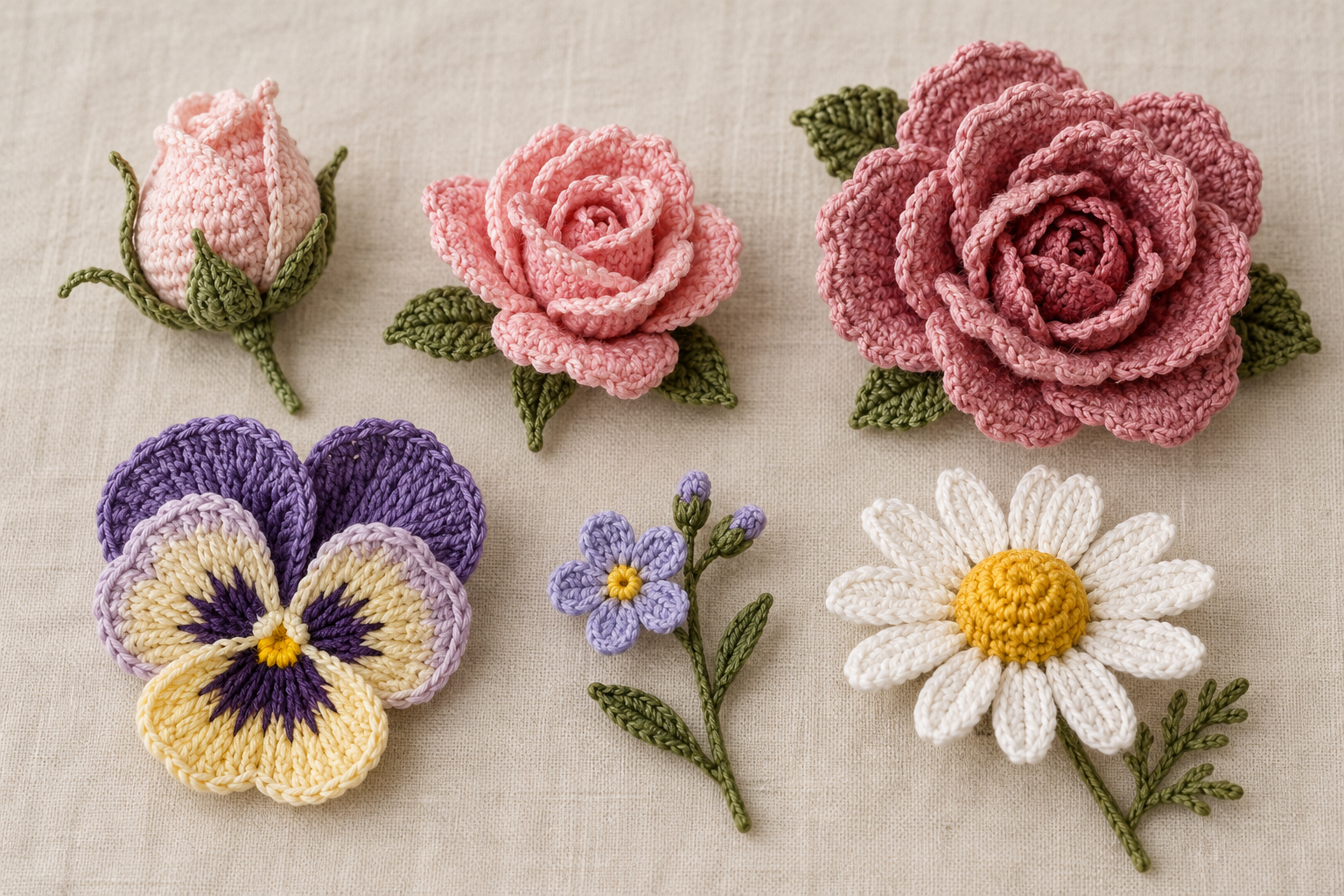
The collection includes three rose designs: Rose Bud, Little Rose and Big Rose. Together, they offer a lovely progression from a compact bloom to a fuller flower with more layers.
The Big Rose builds on a rosebud with additional petals, while the smaller rose offers a less expansive silhouette. For bouquet inspiration, mix a bud with open roses rather than making every bloom the same size. Pale pinks feel gentle and delicate; deeper reds create a stronger focal point.
5. Pansy and Forget-Me-Not: Small Flowers With Personality
Pansy and Forget me not bring color without needing a large flower head. The pansy uses yellow, lilac and violet, while the forget-me-not combines lilac flowers with yellow pearl centers.
Both receive the book’s lowest difficulty rating, making them useful options to consider before its more elaborate flowers. They still involve finishing details, so give yourself time to assemble them neatly. Small blossoms can also fill the gaps between larger flowers without overwhelming the arrangement.
6. Little Flower and Big Flower: Explore Scale and Shape
Two designs are simply named Little Flower and Big Flower. They combine a central base with shaped petals and decorative centers, offering another way to compare a smaller bloom with a more substantial one.
These names describe the designs within the book; they do not guarantee a particular finished measurement. Thread, hook and tension all affect the result. Think of them as options for varying the balance of an arrangement, and check the original pattern’s materials before starting.
7. Lily A, Lily B and Daffodil: Flowers With Distinctive Centers
Lily A and Lily B add more detailed flower shapes to the collection. Their materials include decorative center elements such as gems or beads, and their difficulty ratings are higher than those of the simplest small flowers.
Daffodil offers a different focal point through its separate trumpet-like center and surrounding petals. White and soft yellow give it a fresh spring feeling. These designs suit makers who are ready to spend time on shaping, joining and finishing rather than looking for a quick first motif.
8. Camomile, Daisy, Gerbera Daisy and Sunflower: Sunny Garden Inspiration
This group includes four separate designs: Camomile, Daisy, Gerbera Daisy and Sunflower. White and yellow appear in the camomile and daisy, while the gerbera introduces yellow, orange and brown. The sunflower pairs soft yellow petals with a brown center.
Their familiar outlines make them appealing bouquet choices, but they are not all equally simple. Camomile receives the lowest difficulty rating, while Gerbera Daisy and Sunflower receive the highest. The sunflower also uses filling to give its center dimension. Choose for the amount of construction you want to explore, as well as the finished look.
9. Bellflower A, Bellflower B and Carnation: A Change of Texture
Bellflower A and Bellflower B offer two versions of a shaped bell-like bloom. The collection uses different color combinations and construction details, so they are worth treating as distinct projects.
Carnation adds a ruffled effect, with contrasting white and red details in the suggested materials. Its layered motifs offer a different texture from a smooth tulip or an open daisy. A carnation could bring softness to a mixed arrangement, while bellflowers add variation in silhouette.
10. Bud and Unopened Bud: Finish the Bouquet With Smaller Forms
Alongside Rose Bud, the book includes separate designs called Bud and Unopened Bud. These smaller shapes help a handmade arrangement suggest different stages of growth rather than a vase filled only with fully open flowers.
The Unopened Bud uses filling to support its form, while both designs include stem finishing. Place a few buds near the edges of a bouquet to add variety without introducing another large flower head. They are also worth practicing separately before assembling a larger display.
Add Leaves, Greenery and a Little Garden Detail
The supporting designs include Curly Grass, Leaf, Curly Leaf, Long Leaf, Rectangular Leaf, Big Leaf, Ivy Leaves, Decorative Curl, Fern and Wheat. They offer different ways to frame flowers, introduce height or break up a dense cluster of petals.
The book also includes Butterfly 1, Butterfly 2 and Ladybug as decorative accents. A little garden detail can be charming, but you do not need to use every element. Start with a few leaves that complement your flowers, then decide whether an accent would suit the arrangement.
Materials to Prepare Before You Start
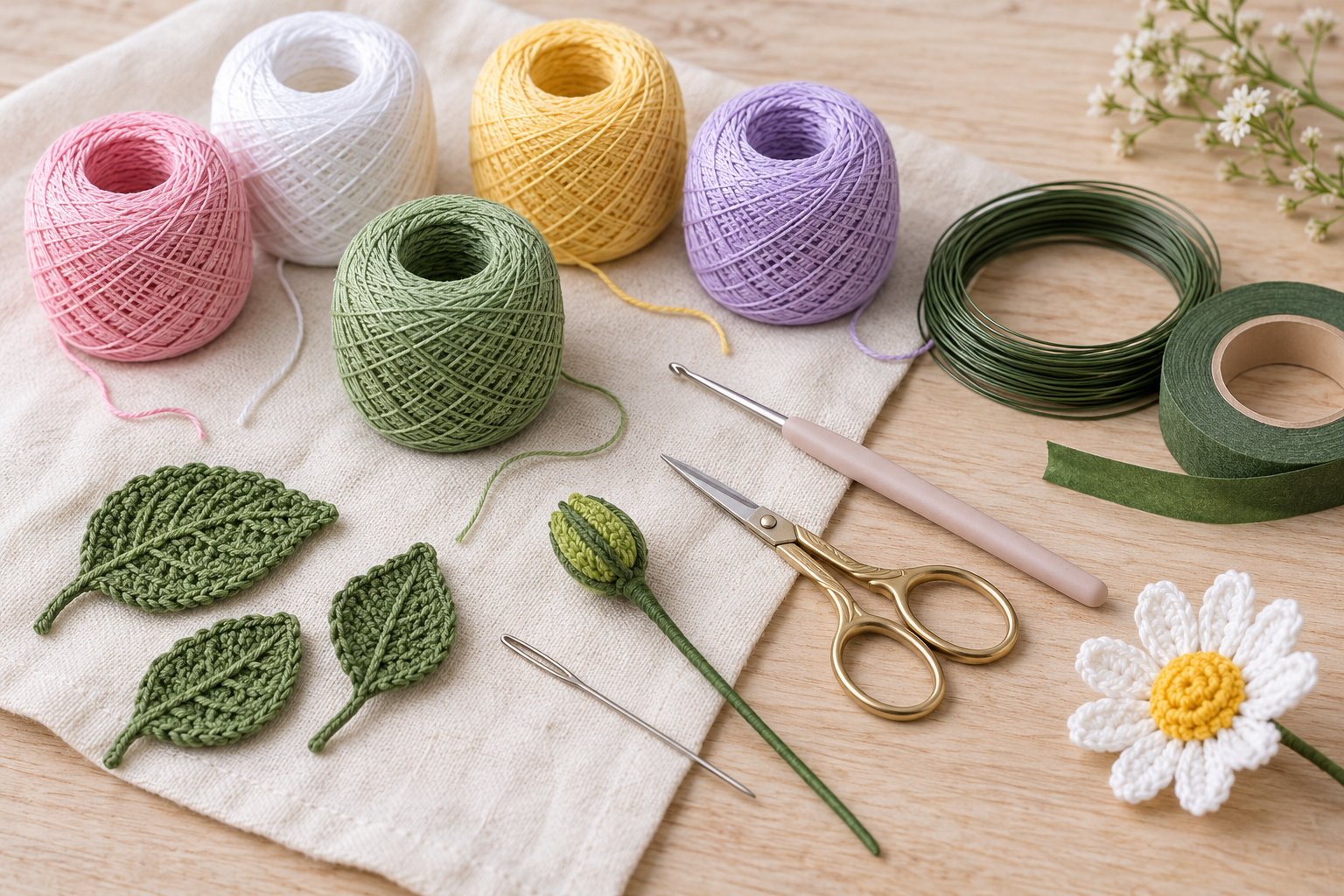
Many designs list fine cotton thread and a 1.90 mm crochet hook. The exact thread, colors and additional supplies vary by project; some also use wool. Check the metric hook size rather than relying only on a letter label, and follow the materials for the design you choose.
Depending on the flower, you may also need floral wire, green floral tape, beads or pearls, fabric glue and a little filling. Keep scissors and a yarn needle nearby for finishing. Many pieces are intended as shaped decorative flowers with stems, so plan for assembly as well as crochet time. For wearable or washable embellishments, use a pattern specifically suited to that purpose rather than attaching a wired display flower.
Choosing Your First Crochet Flower
Start with one small flower rather than a complete bouquet. Pansy, Camomile and Forget me not are among the designs marked with the lowest difficulty rating. Work in a light thread color if that helps you see your stitches, and finish one sample before preparing supplies for several more.
The stitch key includes chains, slip stitches, single crochet, half double crochet, double crochet and taller stitches, along with shaping and decorative techniques. Familiarity with basic stitches is helpful, but assembly can introduce its own learning curve. Use the original pattern and its diagrams for exact stitch counts and construction; this article is an overview to help you choose a project.
Create a Bouquet That Feels Like You
A handmade bouquet does not need every flower in the collection. Choose one focal bloom, a few smaller flowers and some greenery. Repeat a color across the arrangement, vary the flower sizes and leave enough space for each shape to be seen.
Would you begin with a little pansy, a romantic rose or a bright sunflower? Save your favorite idea for your next craft session, and explore more handmade inspiration at Loopmira.